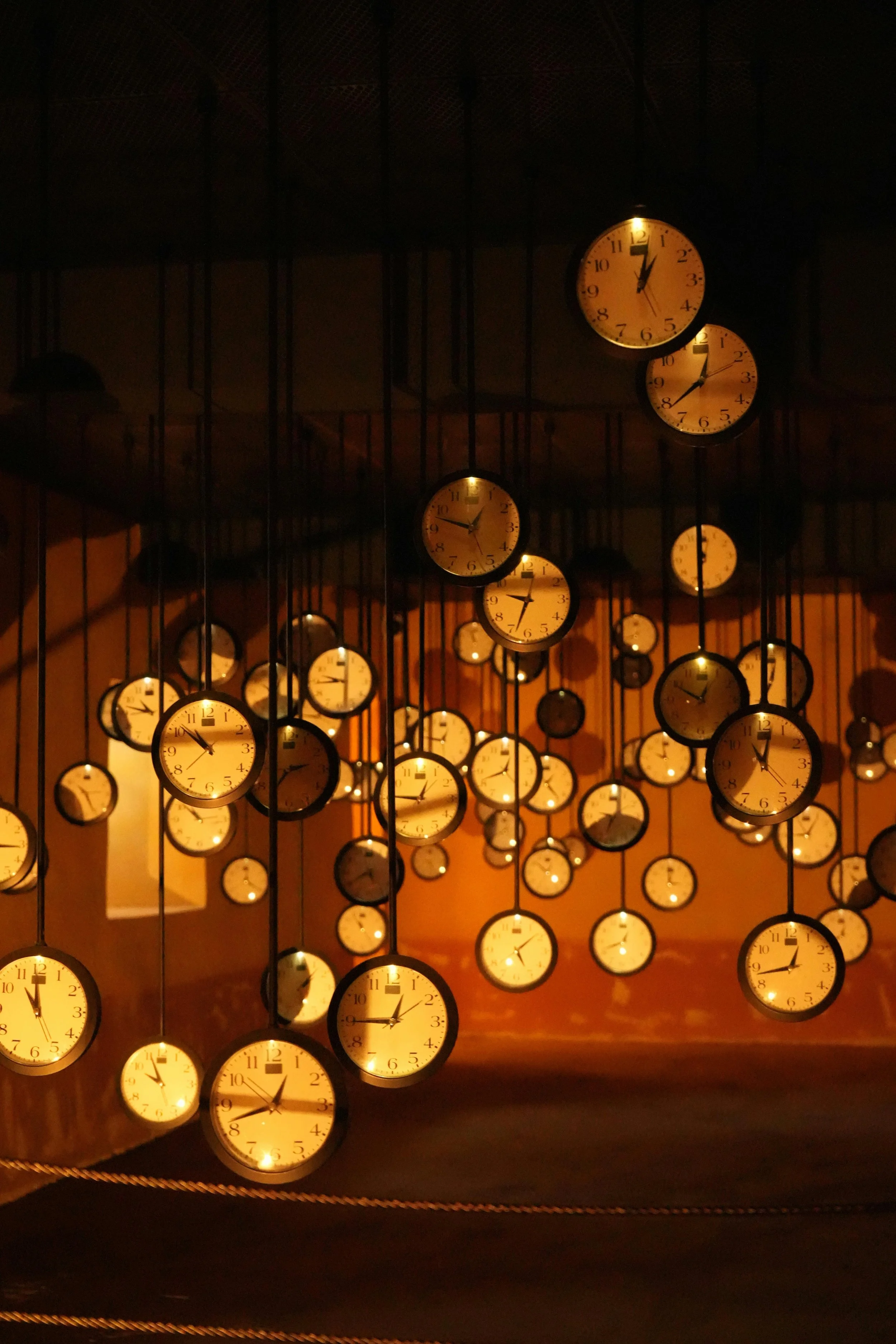
The Elastic Clock
Why Time Flies for Some and Crawl for Others
8 Minutes
Throughout his 76 years, the Great Mind of Hippo struggled with many philosophical and ethical quandaries and contradictions. Walking along the dusty streets of Thagaste in the declining years of Roma’s influence in North Africa, or along the presumably less dusty ones of Milan - a place that in his lifetime was becoming one of the great centres of European thought and religion - he would have, in the style of the great Peripatetics or the later Psychogeographer’s, thought on these things.
To us, this man of Numidia is known as St Augustine, but that moniker would have only been laid upon him after his death, and not officially either, but just through the people’s will and understanding (he was never formally canonised in the later sense of the word, as the process of canonisation we know the Vatican to engage in today did not develop until hundreds of years after his death. A detail).
Why am I blathering on about Augustine, you may wonder? Well, I’m trying to give shape to this essay which, is funnily enough, about a different kind of shape – that of time. Well, kind of; that may be begging the question as to whether or not it indeed has a shape. I’ll get to that later.
“What then is time? If no one asks me, I know. If I wish to explain it, I do not.” So said Augustine in his Confessions. He actually wrote more extensively on the topic in City of God, written during the zenith (if that’s not a linguistic contradiction – perhaps nadir is more appropriate here? You decide, and if you feel so inclined, lemme know!) of the decline of Rome’s western half (portion?). His approach to the cluster of questions was of course theological, so I’m not going to get into any of that here. I am simply using the above quote as a launching pad for a more specific discussion I have been having with myself for a while (something has just been rattlin’ around up there, you know?), and which I thought I would share, in case one only find it of some interest or use.
First, a quick disclaimer. I don’t want this piece to be a general discussion on the nature of time. For one, to write fully about the topic would make Declin and Fall look like the Tiger Who Came to Tea in its brevity. Secondly, I don’t have the scientific training to do so. Rather, I wish to discuss one specific aspect of time: why that when we have more of it, we use it less.
I hope I’ve not lost you already. Perhaps this well-trodden phrase will sum up what I cannot: If you wish to get something done, ask a busy person.
This is a truism I can personally attest to, as I’m sure many of you can, also.
But – why?
Maybe the answer is obvious, and by naval gazing into the subject one can only add confusion and a fog of misunderstanding where once there was clarity, a cleanliness of idea. But I suppose that is what philosophical reasoning is: the why behind the truths, no matter how self-evident. For, in my estimation, self-evidence can so often be the antithesis of deeper thought, of true understanding.
Let’s take a breath here, like new lovers briefly uncoupling only to go again after reenergising their wanton bodies.
As with so much inquiry into time, the phrase sounds paradoxical at first. Intuitively, the least busy person should have the most time (right? Right?!). Yet, in practice, the opposite is often true.
So what, if anything, explains this seeming inconsistency?
Leaning toward a more scientific, material analysis, one explanation comes from psychology - more precisely, behavioural economics. Busy people tend to have stronger executive functioning habits. Cognitive skills such as scheduling, prioritisation, decision-making, and task-switching. Once a person develops systems for handling many responsibilities, adding one more task creates only a small additional cognitive cost. That’s why multitaskers are so good at multitasking – it’s self-generating! In contrast, an idle person may lack structure altogether, so their mental muscles will never get to flex, to stretch, to be shocked into growing. And, to draw the analogy out into an agonising yoga pose – astravakrasana or tittibhasana, perhaps, things I will never achieve unless I wish to spend a month in traction - an unused muscle atrophies.
Therefore, it appears the problem here is not really time at all, but momentum. Human beings often obey a psychological analogue of Newton’s First Law (an object at rest stays at rest, and an object in motion stays in motion at a constant speed and in a straight line, unless acted upon by an external force): active people tend to remain active; inactive people tend to remain inactive.
It’s inertia.
Productivity generates further productivity because routines reduce friction, creates a smoother flow. A busy person already inhabits a state of motion, so they flow, they glide, through the tunnel of time without ever bumping the walls. An unbusy person, in contrast, moves through time’s tunnel like Crash Bandicoot with an inner ear infection.
There is also the phenomenon sometimes called Parkinson’s Law. This particular “law” states that work expands to fill the time available for its completion. Someone with endless free time may delay indefinitely because no time-urgency exists. In opposition, a busy person, constrained by schedules, is forced into efficiency. Basically, as with more physical resources and considerations, scarcity, undertaking the role of an existential shadow, sharpens action.
Modern neuroscience (for there is only really a “modern” neuroscience, if we are being honest, though that is not to discredit the nascent version of the subject which allowed us to get here – the broad and sturdy shoulders of the ancient mighty) adds another layer. Motivation and accomplishment are tied to dopaminergic reward systems. Completing meaningful tasks can reinforce future task engagement. Competence becomes psychologically energising rather than merely exhausting. In that sense, industriousness can become self-sustaining. The research also puts pay to the idea that we are somehow limited energetically in this way. Yes, burnout is a consideration (and I have written on this topic directly in the past), but healthy, productive, affirming business of the mind generates its own forward momentum. In this respect, you are more likely to get burnout from rotting inside of time rather than racing towards the edge of it.
But the above saying is not merely one to be considered by the scientific community, but also by the philosophical one.
Aristotle argued that virtue is formed through habit. A courageous person becomes courageous by repeatedly acting courageously. Likewise, a capable person becomes capable through repeated action. The “busy person” is not simply someone with obligations, but someone whose character has been shaped into responsiveness and agency.
The phrase also challenges our assumptions about time itself. We often imagine time as a quantity, something we can own, like coins in a purse. But lived time is qualitative. Two people may possess the same twenty-four hours while inhabiting utterly different realities of purpose, energy, and direction. A person without commitments may experience time as shapeless and diffuse. A busy person often experiences time as meaningful structure, a thing with architecture and logic.
Existentialist philosophers such as Martin Heidegger believed human beings are defined not merely by thought but by involvement in the world. Projects, responsibilities, relationships, creation – these are the things that define and structure not just our lives, but our fundamental sense of self. Action gives shape to existence. To ask something of a busy person is, in a way, to ask someone already engaged in the fabric of life to continue to weave.
Yet the saying has limits, as most tend to do.
Busyness is not always virtue. Modern societies, those most notorious of societies, often confuse frantic and frenetic activity with meaning. Chronic busyness can conceal avoidance, anxiety, loneliness, or the inability to be still. Bertrand Russell warned that excessive worship of productivity impoverishes the inner life. A civilisation that values only efficiency risks producing spiritually exhausted people. Machines of pure productivity, ensouled by nothing and no-one. Or, as I once heard quipped: if you win the rat race, that just makes you King Rat.
…
Augustine kept himself busy. You see that in his writings, and in the writings about the man. I try to also, and try to make sure that business is as meaningful as possible.
The alternative is hell.
Movement is the great tonic to say many of life’s ailments. Our bodies stiffen with inactivity; pain increases at rest. So too our mental anguish increase. Depression, as has been said, hates a moving target.
Our mind’s must move. One could argue that in this age of mass media and the insincerity and hollowness it encourages in our lives, that the movement of our mind is even more vital than that of the body. Then again, one could also plausibly argue the converse Therefore, move both, as much as possible, in healthy ways, avoiding injury, mental or physical,
I do wonder if the modern fixation on dopamine hits is a terrible simulacrum of this need to keep our mind’s active. That our brains are craving deep nourishment, but without the tools or understand of how to five them to it, we turn to the microdosing alternative. If that is the case, the solutions become simple if not easy: the shiny, flashy things must be seen with more scepticism, treated as threats rather than as friends.
I want to end here by once again mentioning Aristotle. I don’t feel guilty about harping on about the fella in so much of my work. I truly consider him the great encompasser of so much of the human circumstance, in all its varied aspects. Reading him is eating your veggies.
In that bright, quick and musical language, that of bronze and sea winds, he and his compatriot Greeks spoke, he told us to remember, as I briefly mentioned above, that we are our habits.
That’s all. I won’t do your reflecting for you, nor will I encourage conclusions in the minds of others. But I hope I’ve given the reader enough to have a good think about stuff. That’s all I can ever really hope to do - have a think, have a feel.
P.S. Ironically enough, for a piece on time, this is one of the shorter pieces of nonfiction prose I’ve written in a long while.
Funny how that do be sometimes.
Picture by Kader Azra Namuslu