Art and Civilisation
Paglia, Lynch, and That Which Guards
15 Minutes
I don’t know about you, but I’ve always thought existence a strange, strange thing. This feeling has intensified as I’ve aged, increasingly moved from the background of my mind to the foreground. The thought can be overwhelming at times, though I endeavour not to let that overwhelming actually overwhelm in any meaningful life sense.
Seriously though - like, what the actual fuck is all this? And is there a why behind it all?
It’s a big question. Maybe The Big question. And it’s clearly too big for me to answer here – I have neither the time nor the IQ. But I did want to talk about a couple of things that our species has invented, a technology, if you will, to help us come to terms with this strangeness – art and civilisation.
The standard account of civilisation runs something like this: survivalist needs drive agriculture, agriculture produces surplus, surplus enables specialisation, specialisation creates cities, cities produce culture. Art arrives late in this story, and it does so as a luxury, a byproduct, a decoration on an already-functioning edifice, a desire to make the functional pretty.
I believe this account to be wrong, or rather than being wrong, it is so incomplete as to be misleading in every important respect. Thankfully, I am not alone in this belief. A growing body of archaeological evidence, alongside some of the more penetrating cultural thinking of the last century, points to the opposite conclusion: that symbolic and artistic activity is not downstream of civilisation but upstream of it. Art does not ornament the human world so much as it constitutes it. In other words, before mankind raised walls against the howling wilderness that threatened existence itself, it raised symbols against the same wilderness, for the same existential reasons.
Axis Mundi
Recently (well, last year, but in writing terms, that still counts as recent) I wrote about Camille Paglia’s claim that civilisation begins with art (I’m going to be reheating her nachos here).
Paglia argues that art is not a luxury added onto civilisation, but the very thing that separates humanity from mere survival. She claims that the first act of civilisation is symbolic. Acts such as painting a cave wall, carving a god from wood or stone or ivory, keening over the dead, or arranging stones of various sizes into various meanings. In her view, culture begins not with laws or agriculture, but with humanity pushing back against the threats of nature through imagination and the form that emerges from that imagination.
To me there is something powerful in this inversion of the usual tropey story. People who study such things often say civilisation creates art because stable societies finally have spare time, they can indulge the higher parts of the consciousness now that the dread of survival had been tamed, and in this way art becomes an indulgence, a decadence, not something that is required in any meaningful sense. Paglia flips it and says that art itself is the stabilising force that allows civilisation to flourish. To her, ritual, myth, theatre, architecture, sculpture (you name it) bind people together long before bureaucracies ever do. A primitive tribe that paints, dances, or buries its dead ceremonially is already beginning to become a civilisation.
We know that the earliest humans, whose inner lives we can partially access, were already sophisticated visual artists, which entails they were already sophisticated artistic thinkers and feelers. Let’s meet these people and their work, shall we?
Deep inside a cave in the hilly Ardèche of France’s southeast, unknown artists painted the lions, rhinoceroses, and bears of ice aged Europe with dynamic movement and overlapping forms, giving the lucky viewer, even today, a sense of depth, of a world happening within the stone. These are the Chauvet Cave Paintings, and they are around 38,000 years old, making them the oldest known figurative art. The images had no known practical purpose, yet demonstrate perspective, movement, and compositional awareness that would not be matched in the Western tradition for another thirty millennia. These were not primitive scratchings. They were not the childish doodles of bored secondary school kids, daydreaming of lunch and the infinite possibilities beyond. They were acts of extraordinary deliberate intelligence, made in near-total darkness, deep inside the earth, far from any practical necessity.
They were, in every meaningful sense, the beginning of civilisation itself.
Nobody painted a bison at the back of a lightless cave because they were hungry (good luck eating that without chipping your teeth). Something else drove them. In this instance I believe pure image-making was a means of encountering with the sacred.
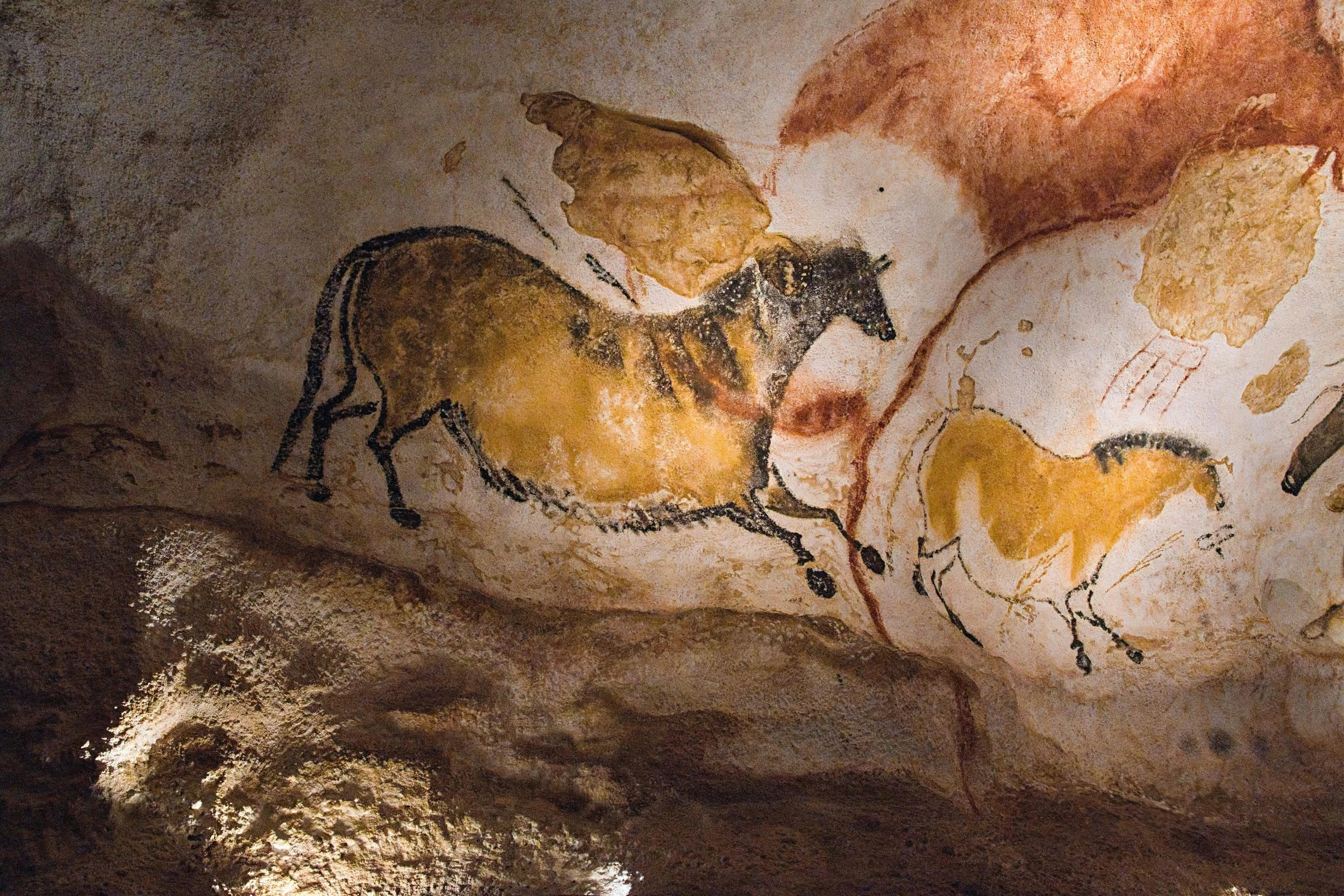
Staying in France, but finding yourself slightly north and slightly more to the west, we find ourselves at the foot of a set of green hills, at the inconspicuous entrance to a cave system. The Lascaux Hall of the Bulls comes in at around 19,000 years old (“modest!”). The great hall is six metres wide, and has seemingly angered bulls up to five metres long charging across its ceiling. It was entered for a purpose archaeologists can only partially reconstruct. But we do know this much at least, that whoever stood in that hall with torchlight moving across those painted flanks felt something that bound them to the others who stood there. Shared awe is the origin of every society ever built (I myself have stood in such neolithic and megalithic places, sometimes far beneath the earth, or in almost total darkness, with others, and felt that bonding). Lascaux, along with Chauvet, it could be argued, are not a time and place before civilisation; they are civilisation, in its earliest and perhaps most essential form – the form from which all other forms can spring.
What demanded places like this is the central question. The most persuasive answer is that image-making was, from the very beginning, a technology of the sacred, a means by which early humans attempted to organise and manage the overwhelming strangeness of existence. That strangeness that perhaps you join me in sharing. The animal painted on the wall is not merely represented, a thing outside of our thing; it is, in some sense, brought within the circle of the human. Art, therefore, even before the tool, was the first attempt to transform raw, indifferent nature into something a community could relate to, fear in the correct, healthy way, and ultimately (hopefully) survive.
So it would seem that before we had shared governance, shared religion, or shared economy, we had shared symbolism. The capacity to create and collectively respond to an image is the precondition for every other form of social organisation. A community that can agree that this mark means that thing has already made the conceptual leap required for language, for law, for memory extended beyond a single lifeform or lifetime. This, when seen through this lens, the cave painting is not a curiosity before history begins. It is where history begins.
We’re not quite done exploring upper palaeolithic Europe, at the time when the last of the neanderthals are taking their final steps on this earth. Moving swiftly as our tiring minds can take us across the dense, grave-ridden forests of the Ardennes, we find ourselves in Germany, a place which became a veritable wellspring of thought on this topic, as you will later see. The Lion-Man of Hohlenstein-Stadel from around 40, 000 years ago is an artefact carved from mammoth ivory. This half-human, half-lion figure is the oldest known sculpture of a composite being. To carve it, the maker, or makers, had to hold two separate categories in mind and consciously merge them. This is the essence of the cognitive act that underlies, as well as artistic expression, all mythology, all theology, and it could be argued, all law. A society capable of imagining the Lion-Man - what he is, what he does, what he represents – it can reasonably be deduced is capable of imagining a god, a king, or a covenant.
Everything follows from this, for it must.
So, we can see that what art gave early civilisation was a shared interior life. The group wearing animal hides and picking at their sore teeth with chicken bones, that gathers around an image, that trembles before the same painted form, is already a proto-society. They aren’t bound by blood in their veins alone, but also by meaning. And it can be argued that this meaning, once ignited, is the most civilising force in human history.
Back to Paglia, she sees art and beauty as primal and dangerous – but, outwardly-contradictory-but-actually-not-at-all-so, also civilising forces - rather than mere matters of taste or decoration. At the centre of her thinking - which blends influence from Nietzsche, Freud, ancient mythology, and the history of religions and art - is the idea that human beings live in tension with nature, constantly, without relent, or the possibility thereof. Nature, for Paglia, is chaotic, violent, sexual, indifferent, and overwhelming. Civilisation arises when humanity pushes back against this chaos through form, order, ritual, and symbolism. Art is therefore not an optional luxury; instead, it is an endless undertaking of resistance against the oblivion that stalks, awaits.
Paglia typically divides reality into two forces: that of The Dionysian (chaos, instinct, ecstasy, nature, sex, violence, dissolution of the self) and of the Apollonian (order, clarity, symmetry, hierarchy, sculpture, architecture, restraint). She argues that great art emerges from the struggle between these forces – the steel-on-steel clash, the explosive energy creating illumination - rather than from harmony alone. (You may recognise this framework – it comes largely from Friedrich Nietzsche’s The Birth of Tragedy).
Beauty, in the view of the New York native, is not simply “pretty”. It is often terrifying or overwhelming. A cathedral that looms over the land, a tragic play, a glamorous, yet heartbreaking movie star, or a Greek statue, painted or stripped, can all produce awe because they impose form upon the chaos of existence. Beauty is therefore linked to power and transcendence. Additionally, Paglia strongly rejects the idea that art is purely political or socially constructed. Instead, she believes great art taps into timeless archetypes and deep biological realities. Sex, death, war, fertility, fear, divinity – all hold an irresistible draw to the artistic, creative mind. Therefore, civilisation is a thin aesthetic veil stretched over the belching caldera of volcanic forces. Art is humanity’s ritual defence against the cruelty and chaos of nature, while beauty is the radiant form that makes this struggle bearable, maybe even at time, dare it be said, enjoyable.
That is why ancient works can still affect modern people as if they were made for us. Because, in a very real way, they were made for us.
Paglia’s ideas are most fully developed in Sexual Personae, where she traces Western art as a continual battle between reason and primal energy. In her work she argues that Western Civilisation is not a progress narrative but a war, one that is sometimes dynamic and blitzing, and other times sluggish, stagnant, trench lined. In this war, the enemy is nature herself. It’s chthonic, feminine, amoral, devouring. In other, more succinct words, it’s Dionysian. Art, she contends, is the Apollonian counterstrike. Form hurled against formlessness; the lit room against the dark wood. The Greeks did not build temples because they loved beauty, or only because they loved beauty. They built them because they were afraid. The statue, the column, the tragedy performed behind masks, these are all apotropaic objects, things made to ward off evil spirits. Likewise, staying in the eastern Mediterranean, the Pharaohs – great and otherwise – developed their system of writing from pictographic art, from image. Thus, the hieroglyph is the precise moment art and civilisation fuse into a single system. Ancient Egypt's entire administrative, religious, and political orders ran on this fusion. The Pharaoh's power was consequently inseparable from the image of the Pharaoh. To control the representation was to control reality. It was to give them power over nature.
The erstwhile cultural historian Lewis Mumford (no known relation to …& Sons) argued in The City in History that the first cities were not primarily economic or defensive structures but symbolic ones, places organised around the tomb, the temple, and the palace, all of which were fundamentally image-producing institutions. For instance, the Egyptian pyramid is the desert city's first principle. A colossal artwork visible from enormous distances, organising the landscape around a single point of sacred power. Mumford's city is not merely a market with walls. Rather, it is a collective artwork, a made environment designed to express and reinforce a community's understanding of its place in the cosmos.
This reframes every ancient city we have ever excavated. Ur, Thebes, Mohenjo-daro, Teotihuacan. These places, largely lost to time and nature, were not primarily administrative centres that just happened to have temples. Instead, they were principally sacred image-environments that happened to develop administration.
The city, therefore, began as art.
Turkey’s Göbekli Tepe is a massive ritual complex of carved stone pillars decorated with animals, worshipful symbols, and abstract forms, that was built over 10,000 years ago, a time before agriculture, before settled life, before any of the conditions supposedly required for monumental architecture to begin manifesting. This place of carefully excavated circles and spirals inverts the standard narrative I mentioned at the beginning of this piece. Here, on this dusty Anatolian steppe, not too far from the Syrian border, people did not first farm and then build temples - they built the temple first. Ergo, the sacred image preceded, and possibly caused, civilisation.
Klaus Schmidt, who led the location’s excavation until his death in 2014, argued that the site was built by hunter-gatherers who had not yet settled, had not yet farmed, had not yet formed what we would recognise as a state. Yet they quarried, transported, and erected limestone pillars weighing up to twenty tonnes, decorated them with sophisticated carved reliefs, and aligned them to the heavens with astonishing astronomical precision. This didn’t aid their hunter-gathering exploits, and an evolutionary biologists may argue would actually detract from it, as they would be burning precious calories they could otherwise use for more hunting, mor gathering.
The implication Schmidt drew, and which subsequent archaeology has supported, is that the need to build ritual and symbolic space may have been what motivated the transition to settled life and agriculture in the first place. People did not settle and then build temples; they built the temple and settlement and agriculture developed around the logistical demands of maintaining it.
So, to Schmidt, like Paglia, like Mumford, art did not follow civilisation, civilisation followed art.
The Romanian religious historian Mircea Eliade introduced us to the concept of axis mundi - the sacred centre around which a human world is organised. His thought repeats Mumford’s and Schmidt’s. Every civilisation, the pipe-smoking man argued, constructs its world around such a centre. Like a mountain, a temple, a tree, a stone. The centre is not discovered but made - and it is always, in its earliest forms, a made image or a decorated place. Göbekli Tepe, for instance, is an axis mundi before cities existed, a carved and ornamented site to which people travelled from hundreds of miles away, around which they organised their calendars, their rituals, their sense of where they stood in the community, on the earth, and in the cosmos. And, if I may be so bold, where they stood inside themselves.
Eliade's insight is that human beings cannot live in undifferentiated space and time. They require a centre, a here that is more real than other places, a centripetal force from which orientation becomes possible. A centre which in this case must hold. Art creates that centre. The decorated caves of France, the carved pillars of Mycenaean Greece, the painted wall in Luxor telling a history - these things are the first acts of world-making. They are the primordial human’s – a creature as confused as I am about existence, perhaps even more so - gesture of saying that this place matters, this place is different, this is where we are.
The Moon Keeps a Second Ocean Beneath the Highway, and Every Lonely Driver Hears It Calling Through the Radio Static
I suppose this is the part of my essay where I must beg you to bear with, it’s gonna get weird (you have come this far, what’s a little further *nervous noises*).
David Lynch never laid out a single formal theory of art in the way Camille Paglia did – that was kind of his thing, to not explain himself, which I have mad respect for - but across his films, interviews, paintings, and writings, a coherent philosophy – if you’re willing to look-see - emerges.
Lynch’s America is a civilisation whose myths and legends still flicker in and out of perceptual existence, long after the gods have left the room (above the Convenience Store). For Lynch, art is a way of accessing hidden realities beneath ordinary life. He believed that beneath the surface of the everyday world lies a deeper realm of dreams, intuition, fear, desire, memory, and spiritual mystery. The artist’s noble task is not to explain this realm rationally (that’s for the eggheads), but to reveal glimpses of it through image, mood, sound, and symbol.
Lynch’s worlds are full of ordinary, sometimes mundane, American structures. Diners, suburbs, highways, nightclubs, small towns frame and shape his world into a last-century Americana - yet beneath them – beneath the kitsch, the spectacle - there is a darkness primordial. In works like Twin Peaks and its spiritual predecessor Blue Velvet, civilisation appears theatrical, almost ceremonial - there are coffee rituals, trance-like dances, songs, red curtains, performances and performativity, and most of all, dream-logic. These aesthetic acts are not superficial in Lynches dreamy mind; they are barriers against psychic and cosmic disorder. And once these civilising rituals collapse, horror emerges, both form nature, and from within the human heart.
Lynch portrayed America as a civilisation suffering symbolic decay. The rituals remain, but belief in them has weakened. The result is an uncanny emptiness. Malls without mallrats; motels, isolating, secretive; fluorescent rooms kept lit for no obvious reason, by no obvious person or thing; and endless roads haunted by an absence of something metaphysical. He understood these truths in a different key and register from most - not through the epistemology of classical learning but through sensation. His films are structured around the same terror Paglia intellectually maps. The classically clean American surface (white picket fences, diner coffee, bobby socks) underlaid by a roaring abyss of sexuality, denial and violence. In Blue Velvet, the opening shot descends from flowers into the soil where beetles consume each other in darkness. The camera doesn't flinch, though the viewer is expected to do so. It goes down and down and down. Lynch's aesthetic is not – and this I believe is key to understanding this worldview - surrealism as escape; it is surrealism as a soulful excavation - a forced confrontation with the underworld-once-overworld that civilisation has paved over but not truly or fully mollified.
North America is a haunted continent. Lynch got this. It’s one reason why cryptozoology and the attending cluster of beliefs are so popular there. Something is up. It’s how a nation barely one hundred years old can already have a gothic aesthetic, as though something ancient persisted below the surface, or in the bay at night, watching with a thousand eyes, or one, the fish-faced men go about their toils. I read once of the founding Europeans, already filled with superstitions, building their settlements on the edge of dark old growth forests that seemed to stretch for thousands of miles backwards, into the unexplored lands. The image struck me and stuck with me. If you briefly sit back and try to imagine the imagination of these people running away with themselves, I think you will be slapped with the same sense of unease that they evidently were. M. Night Shambolic tried to capture this essence in The Village, and predictably failed beyond a few gripping, gimmicky early scenes.
As touched on, a - perhaps the - central idea in Lynch’s (I’m giving all the credit here to Lynch as the visionary, but I’m aware he had co-writers and co-creators - many of whom put a necessarily restraining hand on his shoulder - who deserve their flowers, too!) work is that mystery is essential. He resisted reducing art to a clear message or interpretation. He often argued that explaining a work too directly destroys its power. Art should function like a dream; it should be emotionally true even when logically obscure. The foggy bottom of the unconscious holds a truth all unto itself, and it is a truth worth knowing.
He also believed ideas exist almost independently of the thinker, as phenomena waiting to be discovered, much like the Forms of Plato’s discourses. Through practices like Transcendental Meditation, Lynch described creativity as “catching” ideas from a deeper dreamocean of consciousness. The artist, accordingly, becomes less an inventor than a receiver. Here we once again see the Socratic (yes, I am of the dread race who uses Plato and Socrates interchangeably) idea at play – that for a creator to find the will, they must put a rod up and catch the lightning of the gods. Hence we have a beautiful and perhaps unlikely thing at play: Eastern and Western thought merging in the soul of a mid-century man from small-town Montana.
Lynch’s philosophy, though seemingly incoherent, is actually quite coalescent, and can be broken down into component parts: reality contains hidden layers beneath ordinary appearances; dreams and intuition reveal truths reason cannot; mystery is more powerful than explanation; art should evoke feeling before interpretation; and beauty and horror coexist inseparably.
As with Paglia, beauty does not exist in a vacuum all by itself. It exists through contrast, conflict, with the ugly, the untrue, the evil. This is probably why his work constantly juxtaposes innocence and terror. A perfect suburban lawn hiding insects beneath the grass in Blue Velvet, or the comforting nostalgia of Twin Peaks, with the smiling, oh-so-pretty girls, masking cosmic evil. Lynch treats existence itself as uncanny, presenting it as luminous and horrifying at once. This uncanniness is probably what leads to the weirding feeling so many of us have when we mentally sit back and think about our lives, our existence qua existence.
His artistic worldview is painterly (he actually began his artistic journey as a painter). Consequently, and being an esotericist at heart, his films often feel constructed as moving visual dreampoems rather than traditional narratives. To many a detractor’s lament, mood, texture, silence, sound design, and symbolic imagery matter as much as plot to Lynch, perhaps even more so. Eraserhead, his creepy, dreadful masterpiece, especially feels less like conventional storytelling than it does a moving nightmare painting. The industrial landscapes, distorted soundscapes, surreal imagery, and impossible lifeforms, create meaning emotionally and symbolically rather than rationally. That idea - civilisation emerging through image and myth rather than pure reason - is actually deeply Paglian.
For the boyish-haired man, art is a doorway through which the unconscious speaks in symbols before language can interfere with the messiness and give too much formal order to a truth exists essentially below this plane. Lynch treats dreams not - as is often understood - as escapes from reality, but as reality’s hidden foundation. You could argue (and I suppose that is what yours truly is doing here) that David Lynch treats art not as decoration over civilisation, but as the fragile membrane holding the anti-civilisational chaos at bay. This aligns closely with Paglia’s idea that civilisation begins in symbolic form-making, and engages in the almighty task of keeping the wilderness a thing that exists outside.
What then – if anything - guards civilisation? Both Paglia and Lynch suggest the same answer, arrived at from different directions. It’s not the idea, not the law, not the institution, the building…it is, in actuality, the image. The face of a god. The gargoyle keeping the monster at the threshold of the temple. The slow ceiling fan turning in an overlit room that nevertheless feels like a subterranean space. Civilisation is held together not primarily by reason but by unreason - a shared iconography of terror and beauty, by images powerful enough to metabolise the chaos.
For Lynch, civilisation is not defeated by chaos so much as perpetually negotiating with it, through symbols, performances, and dreams – a candle held unsurely, yet bravely against the abyss. And he’s good at staging and dramatizing this tension. Very good. As with Paglia, who articulates culture as humanity’s Apollonian attempt to contain the savage forces of nature and the unconscious, this civilisational process is a process without end, one that cannot actually end.
This is why the decline of serious art is not merely cultural bad taste but complete civilisational danger. When art loses its capacity for darkness, when it becomes therapeutic, affirmative, safely political (or politically safe), it abandons its guardianship. It stops standing at the threshold and retreats indoors, allowing others to do the fighting for it. But there are no others - the threshold then is unguarded.
And what lives beyond the threshold does not disappear simply because no one is watching it. Rather, it approaches…
The Sacred Assembly
Before I end this piece, I want to buttress this thesis further; pour a little but more concrete into the foundations in the hope of a good setting.
Ernst Cassirer, a mostly forgotten German philosopher writing in the early twentieth century, argued that what separates humans from other animals is not the commonly held belief that we can reason in the abstract, but that we have the capacity for symbolic thought. In his Philosophy of Symbolic Forms, he contends that human beings do not live in a direct relationship with reality. Instead, in a very Lynchian fashion, they live in a universe of their own making, constituted entirely by symbols such as language, myth, religion, art. These are not secondary elaborations on a prior biological reality; they are the primary medium through which humans experience anything at all.
This is a radical claim with radical implications, and therefore I am drawn to it. If Cassirer is right, then the first image-makers in the caves were not adding something to human life, they were performing the very act that made human life, in the full, expressive sense of the word, possible. The painted bison is not a representation of the world. It is the world, transformed into something a community can share, discuss, fear, and revere together. Thus, shared symbolic life is not a feature of civilisation, it is its precondition.
It’s the whole gosh dang cherry pie.
Likewise, Émile Durkheim - a man’s whose writings I first came across when researching suicide for an undergraduate project - approaches the same question from a sociological frame rather than a typically philosophical one - and yet still reaches a compatible conclusion. In The Elementary Forms of Religious Life, he argued that the foundational act of human society is the collective gathering around a sacred object - the “totem”. The totem is always an image, always a made thing (the madeness here is key), always a focal point for shared emotion and collective identity. When a community assembles around it, something happens that cannot be reduced to individual psychology. A collective consciousness is created, a sense of something larger than the self that is nevertheless us.
What is a cave painting if not a totem rendered manifest, rendered permanent (surely even more permanent than the makers could have ever imagined)? The act of painting the bison on the wall, and returning to it, gathering before it, performing before it - this is Durkheim's sacred assembly in its most ancient form. The society is not gathered and then given a symbol; the symbol gathers the society, like at Göbekli Tepe. Remove the sacred image and the community dissolves back into a collection of individuals - wandering the wasteland of existence, outer and inner - which is foundationally antithetical to civilisation. This is why the destruction of images - iconoclasm in all its historical forms - has always been an act of political and civilisational warfare. Of pure genocide. To destroy the image is to attack the civilisational bonds, to separate and send spinning the people. The centripetal of life becoming the centrifuge of death.
Standby, we’re gonna be aura farming now.
Walter Benjamin's concept of the aura - that quality of presence, uniqueness, and sacred authority that an original artwork carries - points toward the same ancient root. Benjamin was writing about mechanical reproduction draining art of its aura in modernity, but the concept inadvertently (so much philosophy and social thinking comes across truth in this inadvertent manner – it’s why it’s so important to always try and look a little bit deeper – though never so deep that you drown) illuminates what prehistoric art was. The cave paintings at Chauvet is pure aura (I know, makes me giggle too, but do try and break the spell of modern neologisms). They are unreproducible (despite mighty attempts), site-specific, demanding physical pilgrimage, and inseparable from its location in the dark body of the earth. The power of the place’s art was entirely bound up with the fact that, in order to experience it, to know it, one had to go there, had to carry fire into the darkness, had to stand in that particular place before that particular wall.
This is ritual. And ritual is, in Cassirer’s, Durkheim's and Benjamin's overlapping frameworks, the engine of social cohesion. The aura of the sacred image compels the community to gather, to repeat the gathering, to transmit the obligation to gather to the next generation. Art in this oldest sense is the technology of social memory and communal identity.
It is a civilisational technology. It is the civilisational technology.
Addendum: Survival
There’s a man named Aby Warburg (yes, of that family. If you know, you know. If you don’t, I invite you to find out – your historical head may spin) and he once nearly wrote a book.
He was an historian of art, and his great unfinished project, the Mnemosyne Atlas, was an attempt to map survival, to show that human visual memory operates across thousands of years, that images carry a charge - what he called Pathosformel, formulas of passion - that can be dormant for centuries and then reactivate.
Warburg spent his career (arguably his life) pursuing what he called Nachleben (you may have noticed the preponderance of German words and terms and names in the pursuit of this truth. Romantic German metaphysics is truly top tier) - the afterlife of images, the way certain visual forms and gestures survive across millennia, migrating from ancient Greece into Renaissance painting, from Babylonian astrology into Florentine frescoes. Warburg's work implies something profound about the relationship between art and civilisation, and in doing so echoes Paglia’s refrains and Lynch’s dreaminess – the idea that civilisations are held together not only by shared institutions and economies but by shared image-memories that operate below conscious awareness. When a Renaissance painter depicts a figure with arms flung wide in ecstasy, they are (perhaps) unknowingly drawing on a gesture carved in and ancient Maenad friezes some two thousand years earlier; when an aspirational, grafting novelist of today’s world constructs a story with an arch and essentialness that just makes sense, they are (perhaps) unknowingly adhering to Aristotle’s prescriptions on storytelling.
Civilisation is, in part - in crucial part, in nascent part - a vast unconscious image-archive, and art is the medium through which that archive is continuously transmitted and renewed.
This may be giving you Jung. Me too, dear reader, me too.
I Have a Pen, and I Must Scream
No more Jung in my diet, however. If only for my cholesterol. Much like with Aristotle, anyone who regularly reads me or even those unfortunate to actually know me, will take it as a given that both men’s thoughts permeate my own. I do not want to be a repetitive bore; there are few things worse than being a repetitive bore.
Art keeps the beast at bay. Puts a shape on the shapelessness of being. I believe this. It does so both for myself, and for civilisation as a whole. After all, the entire universe of existence and experience is held in each human heart.
I lean into this and try to create on this very principle. Creation illuminates and safeguards against those monsters on the outer threshold, but most importantly for me, those on the inner one, too. The chomping things that eat everything, and finish with an impolite burp, from the inside out.
Will we, as a wretched species, ever truly understand existence? I don’t know, but I doubt it. We will probably have evolved into something else, something hopefully a bit better - at least orthopedically - by the time we even get close to such knowledge.
So next time existence just seems too confounding, too strange, too weird, go for a long walk, try and touch some grass and, if you can, smell a blue rose.
Photo by Reinhard Bruckner